Building on insights from the Mario Draghi report, "The Future of European Competitiveness", this year’s ESI Symposium focused on the urgent need to boost productivity to secure Europe’s competitive edge. With growing global demand for sustainable and transformative technologies, the engineering sector plays a pivotal role.
The symposium explored how enhanced research, knowledge sharing, and streamlined collaboration can drive the next wave of innovation. Key topics included the use of generative AI and model-based techniques to tackle complexity in cyber-physical systems — a challenge that remains central to high-tech engineering.
Accelerate the innovation of engineering
Opening presentation by Masoud Dorosti, Jacco Wesselius
The gap is growing between ambition and execution
Europe’s competitiveness is under pressure. Productivity growth has stalled, and R&D investment lags behind global leaders. In the Netherlands, progress depends on innovation, not workforce expansion.
The Mario Draghi report on European competitiveness calls this an existential challenge -urging a major boost in productivity and innovation to secure Europe’s future.
At TNO-ESI, we believe smart engineering methodologies and strong collaboration between industry and education are key. This symposium highlights proven tools to accelerate innovation. Together, we can turn today’s challenge into tomorrow’s opportunity.
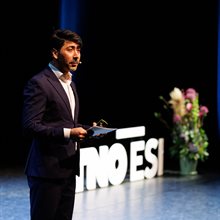
Gerrit Muller, TNO-ESI Professor Systems Engineering University of South-Eastern Norway (USN) INCOSE Fellow
Academic keynote
A vision on the future of Systems Engineering, what capabilities will we need?
The world around us is changing fast, technology keeps evolving much, and the solutions that we develop are increasingly a result of many interacting socio-technical systems. As a consequence, (systems) engineers need another competence profile, other methodologies, while organizations need new capabilities and better infrastructure.
In this presentation, we will look at the trends and the consequences for the high-tech industry, which we illustrate with examples from the offshore industry in Norway. Then we discuss the consequences for research and education, how can we help the high-tech industry to develop the systems engineering capabilities that fit the future?
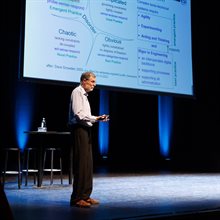
Wei Li, Senior Vice President Development and Engineering Software at ASML
Industrial keynote
Unlocking next wave of accelerated innovation by AI
As AI reshapes the global technology landscape, its influence on engineering innovation is profound and accelerating. At ASML, we stand at the crossroads of this transformation - both as a key contributor to AI innovation through our leading-edge lithography systems and as an explorer in applying AI to enhance our own engineering practices. In this keynote, I will discuss the dual role ASML plays in the AI revolution: driving the semiconductor advancements that empower AI, and embedding AI within our development and engineering workflows to elevate productivity, precision, and creativity. As we look ahead, we must rethink engineering—not as a static discipline, but as an evolving, intelligent ecosystem.

Parallel sessions
P1 Future-fit organizations
The current trends in the high-tech industry present significant challenges and opportunities for organizations. It is crucial to understand and address these changes by developing effective strategies and best practices to thrive in this new era. Adopting an approach where technology and human skills complement each other can lead to more sustainable, resilient, and human-centric industrial practices, ultimately delivering better value for customers and stakeholders.
Moderator: Joana Teixeira, TNO-ESI
- Paul Hilkens, Vice President Research & Development, Canon Production Printing
- Sezen Acur, TNO-ESI - Research Fellow
- Marloes van de Wal, Vanderlande - Managing Director Innovation Strategy and Transformation
- Radhika Vijaykumar Nedungadi, Vanderlande - Manager Platform Integration and Quality assurance
- Sapfo Tsoutsou, Eindhoven University of Technology - Project Manager for NXTGEN Systems Engineering
P2 The quest for engineering productivity: a synthesis-based approach
The high-tech industry is challenged to increase productivity due to increasing complexity of its systems and a shortage of skilled engineers. Logic, code and configuration synthesis from increasingly high-level descriptions is a key promise of model-based engineering and enables automation in many areas, including logic synthesis and implementation of supervisory controllers and synthesis and deployment of product variants.
This track will explore recent advancements in synthesis-based engineering and showcase its productivity benefits using examples from various domains.
Moderator: Ben Pronk, TNO-ESI
- Hans Schurer, Thales Nederland BV - Study manager R&T, Technical directorate & Innovation
- Benny Akesson, TNO-ESI, University of Amsterdam - Senior Research Fellow
- Jeroen Kouwer, Thales Nederland - Software Architect
- Dennis Hendriks, TNO-ESI, Radboud University - Research Fellow
- Prabhat Kumar Sharma, VDL-ETG T&D - Mechatronics Design Engineer
- Lars Moormann, Rijkswaterstaat - Consultant Industrial Automation
P3 Intelligent diagnostics: boosting equipment effectiveness
High-tech manufacturers are seeking ways to improve the servicing of their systems. This need is driven by the goal of ensuring overall equipment effectiveness, managing the ever-increasing complexity of systems, and addressing the challenge of scaling service organizations. Intelligent diagnostics leverages system knowledge, real-time data, and AI techniques to assist in designing diagnosable systems and to provide digital tools that support human decision-making.
Moderator: Marco Vicari, TNO-ESI
- Mauro Barbieri, Philips Innovation & Strategy -Principal Architect Services
- Jimmy van Schoubroeck, ASML Research, Senior Mechatronics Researcher and
Thomas Nägele, TNO-ESI - Research Fellow - Eelco Schillings, Canon Production Printing - Department Manager – Technology Development and
Leonardo Barbini, TNO-ESI - Research Fellow
P4 Understanding and evolving systems with Generative AI
Development and use of high-tech systems generate large volumes of data—code, documentation, logs, operational data, and quality records—crucial for system and software maintenance and evolution. However, its complexity makes it challenging for engineers to interpret and use effectively. This track explores how generative AI, combined with traditional techniques, can help analyze diverse data sources, provide actionable insights, improve efficiency, and make maintenance and development more manageable.
Moderator: Rosilde Corvino, TNO-ESI
- Gernot Eggen, Philips Ultrasound - Software Leader
- Alok Lele, ASML - Project Manager for Twinscan Software Research and Innovation
- Lina Ochoa Venegas, Eindhoven University of Technology - Assistant Professor
- Dennis Dams, TNO- ESI - Senior Research Fellow
- Ivo Canjels - Philips Image Guided Therapy - Software Architect
Contact us
-

Judith Tesser
Functie:Communication ManagerSpecialisatie niet bekend-
Telefoon:+31 6 21 30 83 48
-
E-mail:E-mail Judith
-
LinkedIn:Judith on LinkedIn
-