
Eclipse Logistics Specification and Analysis Tool (Eclipse LSAT™) is a performance workbench for the rapid design-space exploration of supervisory controllers that orchestrate the behavior of flexible manufacturing systems. Eclipse LSAT provides an integrated development environment for the lightweight modeling of the system resources, the system behavior and the timing characteristics. The tool provides various visualizations to explore the controlled system behavior and analysis and optimization techniques to improve the overall system performance.
Main functions
Eclipse LSAT provides the following functionality to design high-level supervisory controllers.
Modeling
A domain-specific language to model the system and the supervisory controller.
The uncontrolled system is specified in terms of resources, peripherals, actions, motion profiles, and high-level activities. The supervisory controller is specified as a network of finite-state automata, or as sequences of activities that should be (repeatedly) executed.
Eclipse LSAT provides design-time feedback to the user and validates that the specification is consistent.
Analysis
Eclipse LSAT provides means to analyze the productivity characteristics of the system including makespan, throughput, and latency. Furthermore, it can analyze the critical path and highlight bottlenecks in the system. These analysis techniques can be used to perform a design-space exploration to improve the supervisory controller design.
Visualization
The productivity of the system is shown graphically using Gantt charts. The system specification can also be done using graphical editors for the motion profiles and activity specifications.
Validation
Using conformance checking, the implementation can be validated against the specification.
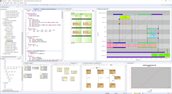
A screenshot of the Eclipse LSAT IDE. On the top you see the textual and graphical editor for activities, and a Gantt chart visualization of the system behavior. On the bottom, you see the graphical editors for the system specification, and a visualization of a point-to-point motion.
Installing Eclipse LSAT
Eclipse LSAT is available as a portable IDE and also as a feature for the Eclipse IDE through the P2 update site repository.
Installation instructions can be found on the Eclipse LSAT website.
Further information
Popular publications related to Eclipse LSAT
Scientific publications related to Eclipse LSAT
-
Tool overview: B. van der Sanden, Y. Blankenstein et al., “LSAT: Specification and Analysis of Product Logistics in Flexible Manufacturing Systems”, in IEEE 17th International Conference on Automation Science and Engineering, 2021
-
Description of the activity specification language;B. van der Sanden, J. Bastos et al., “Compositional specification of functionality and timing of manufacturing systems,” in Forum on Spec. and Design Languages. IEEE, 2016, pp. 1–8.
-
Stochastic critical-path analysis; J. Bastos, B. van der Sanden et al., “Identifying bottlenecks in manufacturing systems using stochastic criticality analysis,” in Forum on Specification and Design Languages, FDL 2017, Proc. IEEE CS Press, 12 2017.
-
Description of the performance analysis techniques;B. van der Sanden, “Performance analysis and optimization of supervisory controllers,” Ph.D. dissertation, Eindhoven University of Technology, 2018.
-
Case study in modeling the wafer logistics in lithography machines; B. van der Sanden, M. Reniers et al., “Modular model-based supervisory controller design for wafer logistics in lithography machines,” in 18th ACM/IEEE International Conference on Model Driven Engineering Languages and Systems, MoDELS 2015, Ottawa, ON, Canada
Contact us
-

Jos Hegge
Functie:Program ManagerSpecialisatie niet bekend-
Telefoon:+31 88 866 54 20
-
E-mail:E-mail Jos
-
LinkedIn:Jos on LinkedIn
-