
Synthesis-Based Engineering
Traditionally, supervisory controllers are manually designed. This quickly becomes infeasible since the complexity is typically too high for engineers to fully comprehend, leading to design errors. Synthesis-Based Engineering provides design assistance to help manage this high complexity, leading to higher-quality controllers at lower effort and cost compared to traditional engineering.
Synthesis-Based Engineering (SBE) is a methodology for the correct-by-construction development of supervisory controllers for cyber-physical systems, combining model-based engineering with computer-aided design. With SBE, correct supervisory controllers can automatically be computed based on formal specifications of the to-be-controlled system and its control requirements. This allows engineers to focus on specifying what the system should do, and leave the search for a guaranteed safe and correct solution (the how) to the computer. This approach improves quality, reduces engineering effort, and shortens development times.
The following video further introduces SBE and compares it to alternative engineering approaches.
SBE allows producing unambiguous, complete, consistent, and up-to-date control specifications, leading to higher quality controllers at similar or even lower effort and costs compared to more traditional engineering approaches. This holds especially for larger and more complex systems, where it is more difficult to consider all the situations that may occur, and how they impact the requirements.
Benefits of SBE
Correct‑by‑Construction Control Software
SBE eliminates entire categories of defects by generating logic guaranteed to meet all specified constraints across all operating conditions.
Reduced Engineering Effort
Automation reduces manual controller design, verification, and debugging, which are domains that traditionally consume significant engineering hours.
Shorter Development Times
Organizations have reported significant reductions in design and stakeholder‑alignment time when adopting SBE.
Better Collaboration Across Stakeholders
Early simulation and shared formal specifications give to all stakeholders, from software engineers to domain architects and from operators to maintenance personnel, a clear understanding of intended behaviour.
Increased Safety and Reliability
SBE ensures system variants and edge cases are handled consistently, boosting operational safety and overall system dependability.
Success stories
SBE is designed for complex, safety‑critical, or variant‑rich systems, including:
- Public infrastructure (water locks)
- Medical domain (MRI scanner)
How it works
The following figure shows the process of applying SBE.
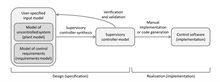
The starting point is a model-based specification of the to-be-controlled system often called the plant, together with a specification of the control requirements for this plant. To these input models, supervisory controller synthesis is applied, resulting in a model of the supervisor for controlling the plant. The synthesis procedure ensures that all specified requirements are satisfied by the synthesised supervisor, so that the controlled system adheres to the requirements in every possible situation. Validation and verification can be applied to determine whether the specified plant and requirements, and by extension the supervisor, achieve the desired system behaviour. If this is not the case, the plant and requirements can be adapted and a new supervisor can be synthesised with the push of a button. Once the desired behaviour is obtained, an implementation of the controller can automatically be obtained from the supervisor model, by generating code for its control software.
Methodology Steps
1.Requirements Capture
Engineers define functional, safety, performance, and exception‑handling requirements.
2.System Modelling
Engineers use a formal modelling language (e.g. the CIF language from the Eclipse ESCET™ toolkit) to formally specify system behaviour, via automata definitions.
3. Synthesis
Based on the models, the synthesis engine computes a controller that satisfies all requirements. It systematically explores the modelled system's state space to derive correct‑by‑construction logic, for every possible scenario and system state.
4. Validation & Verification
Through interactive simulation and formal checks, engineers validate the synthesised controller's behaviour against expectations, ensuring usability, safety, and performance.
5. Implementation & Deployment
The verified controller is automatically translated into executable code, aligning with modern model‑based engineering pipelines.
Further information
Interested in collaborating or learning more? Contact us today.
Contact us
-

Benny Akesson
Functie:Science LeadSpecialisatie niet bekend-
Telefoon:+31 88 866 54 20
-
E-mail:E-mail Benny
-
LinkedIn:Benny on LinkedIn
-
-

Dennis Hendriks
Functie:Senior Research FellowSpecialisatie:Software Behavior-
Telefoon:+31 88 866 54 20
-
E-mail:E-mail Dennis
-
LinkedIn:Dennis on LinkedIn
-