
Model Inference and Differencing Suite (MIDS)
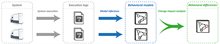
MIDS aims to prevent regressions and reduce the risks for software changes. It provides the following functionality.
Automated behaviour modelling
Automatically infer multi-level models of software behaviour from execution logs for existing software components. These models provide insight into how the system behaves from a high abstraction level, and allow engineers to zoom into specific lower-level details that are relevant for them.
Behavioural change impact analysis
Compare behavioural models for change impact analysis. This provides a multi-level report that indicates how the system behaviour differs with different versions of the software. Engineers can inspect this report, by step-by-step zooming in on parts of the system that have changes, to get insight into what these changes are and whether they are expected.
Main benefits
Reliable insight into current behaviour
The inferred models provide insight into the current software behaviour, which is essential for making correct software changes.
Accelerated adoption of model‑driven engineering
The inferred models can also serve to bootstrap the introduction of Model-Driven Engineering (MDE), ensuring the new models closely resemble the current behaviour, while also reducing the need for laborious and error-prone manual modelling
Reduced risk during software evolution
The software behaviour (models) of different software versions can be compared to find differences, detect regressions and reduce risks for software changes, such as patches and redesigns.
The following video further introduces the MIDS approach and explains its benefits.
Open-source project
The MIDS approach and tool have been developed in collaboration by TNO-ESI and ASML in the Transposition applied research project. To allow widespread use of MIDS, it has been open-sourced under the MIT license.
The behavioural comparison approach of MIDS internally makes use of gLTSdiff, which is a library for comparing the structures of two or more graph models and visualizing their differences. The gLTSdiff library has been open-sourced under the MIT license.
Further information
Contact us
-

Dennis Hendriks
Functie:Senior Research FellowSpecialisatie:Software Behavior-
Telefoon:+31 88 866 54 20
-
E-mail:E-mail Dennis
-
LinkedIn:Dennis on LinkedIn
-
-

Wytse Oortwijn
Functie:Senior Research FellowSpecialisatie:Software Behavior-
Telefoon:+31 88 866 54 20
-
E-mail:E-mail Wytse
-
LinkedIn:Wytse on LinkedIn
-
-

Jos Hegge
Functie:Program ManagerSpecialisatie niet bekend-
Telefoon:+31 88 866 54 20
-
E-mail:E-mail Jos
-
LinkedIn:Jos on LinkedIn
-